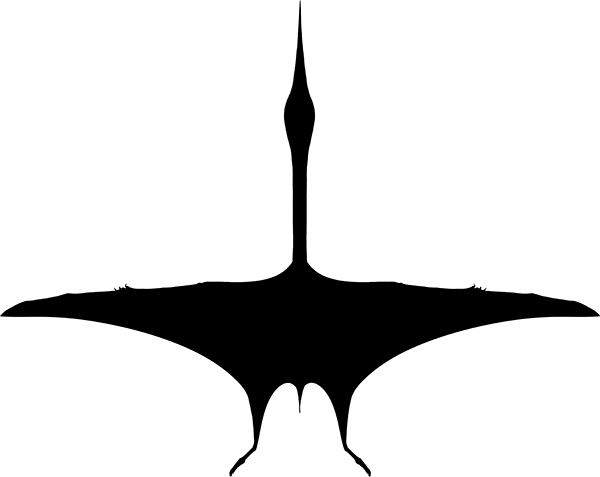
Azhdarchidae
The biggest beasts to take to the skies, these animals broke records when it came to flight and pushed pterosaur limits to new heights.
Pterosaurs
25 genera-
 Maastrichtian
Aerotitan
"Titan" though its name might be, this pterosaur was hardly impressive in terms of size. But it is the first-known South American azhdarchid, and this in itself makes it a find of massive importance.
Wingspan 5 m -
 Albian
Alanqa
Africa's first real azhdarchid discovery was also a neighbor of a few famous dinosaurs like the fish-eating Spinosaurus and the vicious Carcharodontosaurus.
Wingspan 4 m -
 Campanian
Albadraco
Azhdarchids like Albadraco were the top predators on ancient Hateg Island.
Wingspan 6 m -
 Cenomanian
Aralazhdarcho
Aralazhdarcho hunted near the shore of an ancient sea covering most of southern and western Europe.
Wingspan 3 m -
 Maastrichtian
Arambourgiania
The only known fossil of Arambourgiania was found by chance near the side of a railway in the 1940s. It represents one of the first discoveries of an azhdarchid, and one of the largest of all known pterosaurs.
Wingspan 7 m -
 Maastrichtian
Argentinadraco
This Argentine pterosaur may have used its blade-like jaws to find food in beach sands.
-
 Turonian
Azhdarcho
This animal lent its name to a whole family of pterosaurs. The researchers who discovered Azhdarcho in 1984 could not have known just how bizarre it was in life.
Wingspan 4.5 m -
 Santonian
Bakonydraco
This medium-sized Hungarian tapejarid was also the first of its kind to be discovered in Europe, but classified as something totally different.
Wingspan 4 m -
 Campanian
Bennettazhia
This pterosaur found in shallow marine deposits is the only one known from the U.S. state of Oregon.
Wingspan 4 m -
 Campanian
Bogolubovia
Russia’s first discovered pterosaur fossil was a partial neck vertebrae from a medium-sized azhdarchid.
-
 Barremian
Chaoyangopterus
They were not the long-necked monster-stork azhdarchids but were probably powerful predators in their own right. Chaoyangopterus gave its name to a whole new breed of terrestrial stalker pterosaur, the likes of which cropped up again and again during the Early Cretaceous.
Wingspan 1.85 m -
 Campanian
Cryodrakon
Paleontologists thought the first bones from this giant Canadian pterosaur were from Quetzalcoatlus.
Wingspan 10 m -
 Aptian
Eoazhdarcho
Small Eoazhdarcho was a predator of land animals in the forests of ancient China.
Wingspan 1.6 m -
 Aptian
Eurazhdarcho
This man-sized azhdarchid was one of the smallest in its family and lived on an island of dwarf dinosaurs. It was still a fierce predator in its own right though, and not one a small animal would like to meet.
Wingspan 3 m -
 Maastrichtian
Hateg Island Azhdarchid
This unnamed pterosaur is one of three azhdarchids that acted as top predators on an island in prehistoric Romania.
-
 Maastrichtian
Hatzegopteryx
The isle of dwarf dinosaurs was ruled by a pterosaur as tall as an elephant, with a heavy build and a massive stabbing beak. Hatzegopteryx was also one of the most powerful flying animals ever, and it reigned over its island domain with iron wings.
Wingspan 11.5 m -
 Maastrichtian
Hornby Island Azhdarchid
Meet the cat-sized relative of the giraffe-sized azhdarchids that lived on Canada's west coast at the end of the Mesozoic.
-
 Campanian
Mistralazhdarcho
This French pterosaur is one of the most completely known European azhdarchids.
Wingspan 5 m -
 Campanian
Mongol Giant
Three neck bones from Mongolia represent one of the largest pterosaurs ever discovered.
-
 Campanian
Montanazhdarcho
Not all pterosaurs from the end of the Mesozoic were giants, Montanazhdarcho from the Campanian of Montana had a wingspan of “only” 2.5 meters or 8 feet.
Wingspan 2.5 m -
 Maastrichtian
Navajodactylus
Known only from a few isolated bones, Navajodactylus was found in New Mexico and Alberta.
Wingspan 3.5 m -
 Maastrichtian
Phosphatodraco
This azhdarchid hunted in arid northern Africa in the final one million years of the reign of the pterosaurs.
Wingspan 5 m -
 Maastrichtian
Quetzalcoatlus
The tallest flying animal ever, and often seen sharing the title of "Largest Flying Vertebrate" with Hatzegopteryx, this was also one of the last of its kind. Quetzalcoatlus soared over North America, meeting the famous likes of T. rex and Triceratops before vanishing like the rest of its neighbors 66 million years ago.
Wingspan 10 m -
 Campanian
Radiodactylus
The only known specimen of Radiodactylus was found on the grounds of a nuclear power plant and named for radioactivity.
Wingspan 1.5 m -
 Campanian
Zhejiangopterus
One of the best preserved azhdarchids, Zhejiangopterus was also instrumental in heightening our understanding of these impressive animals.
Wingspan 3.5 m
