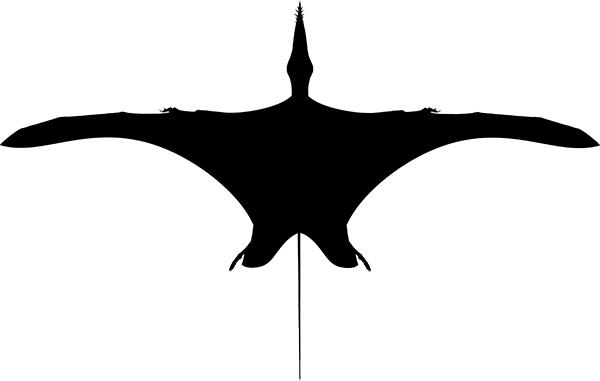
Rhamphorhynchidae
Long-tailed and short-beaked, these winged beasts were great revolutionaries in the field of paleontology. We know them from the inside out from some of the best fossils ever known.
Pterosaurs
17 genera-
 Bathonian
Angustinaripterus
We don't often think of pterosaurs when we hear of China, but the country has revealed some interesting as well as relatively ordinary finds. One of these was Angustinaripterus, the quintessential Jurassic flier.
Wingspan 1.6 m -
 Kimmeridgian
Bellubrunnus
The "beautiful one of Brunn" had wingtips that curved forward gracefully, a rather new and hitherto-unseen trait in a pterosaur.
Wingspan 30 cm -
 Tithonian
Cacibupteryx
Named for the Taino lord of the sky, Cacibupteryx fished in the ancient Gulf of Mexico.
Wingspan 2 m -
 Toarcian
Dorygnathus
This Early Jurassic pterosaur hunted ancient seas with teeth perfect for grasping slippery prey.
Wingspan 1.5 m -
 Oxfordian
Fenghuangopterus
This small Chinese pterosaur is the earliest known scaphognathine.
Wingspan 95 cm -
 Tithonian
Harpactognathus
The Morrison Formation, home of giant dinosaurs of the Late Jurassic was also home to Harpactognathus gentryii, one of the largest long-tailed pterosaurs known.
Wingspan 2.5 m -
 Oxfordian
Jianchangopterus
Jianchangopterus was one of the smallest-known pterosaurs, being only about as big as a robin.
Wingspan 32 cm -
 Barremian
Klobiodon
This pterosaur used its teeth to form a cage to trap fish.
Wingspan 1.7 m -
 Tithonian
Nesodactylus
First collected in 1918 while looking for fish fossils, Nesodactylus was one of the first Jurassic pterosaurs discovered in the Americas.
Wingspan 1.2 m -
 Barremian
Orientognathus
This Chinese pterosaur was one of the last long-tailed forms to live.
Wingspan 1.1 m -
 Toarcian
Parapsicephalus
This early pterosaur is named for its discoverer, Reverend D. W. Purdon.
Wingspan 1.8 m -
 Oxfordian
Pterorhynchus
Another animal known for the preservation of fluffy fur and skin elements. Pterorhynchus comes from Middle Jurassic China, and it was actually under wraps for a very long time, being unknown to the public despite its value to scientists.
Wingspan 85 cm -
 Barremian
Qinglongopterus
Qinglongopterus is a Middle Jurassic rhamphorhynchid from China. Known from just one specimen, it may have been the direct ancestor of Rhamphorhynchus which lived ten million years later in Germany.
Wingspan 30 cm -
 Tithonian
Rhamphorhynchus
A very well-known pterosaur from Jurassic Germany, this small toothy fisherman is also known from some excellent remains preserved in marine limestone.
Wingspan 1.8 m -
 Kimmeridgian
Scaphognathus
The German pterosaur roster expands with the predatory Scaphognathus. This thick-jawed creature was not hunting fish but instead took on small prey in the scrubby deserts of the island around it.
Wingspan 90 cm -
 Oxfordian
Sericipterus
This Jurassic pterosaur is one of the largest known long-tailed forms.
Wingspan 1.75 m -
 Oxfordian
Sordes
The pterosaur that showed the world its true colors as a furry, warm-blooded flier, Sordes, Latin for the word "filth", is one of those rare Kazakhstan gems. But filthy, it certainly is not but instead a revolutionary. It hails from the unlikeliest of locations but was instrumental in understanding pterosaur life as a whole, and how it worked.
Wingspan 65 cm
