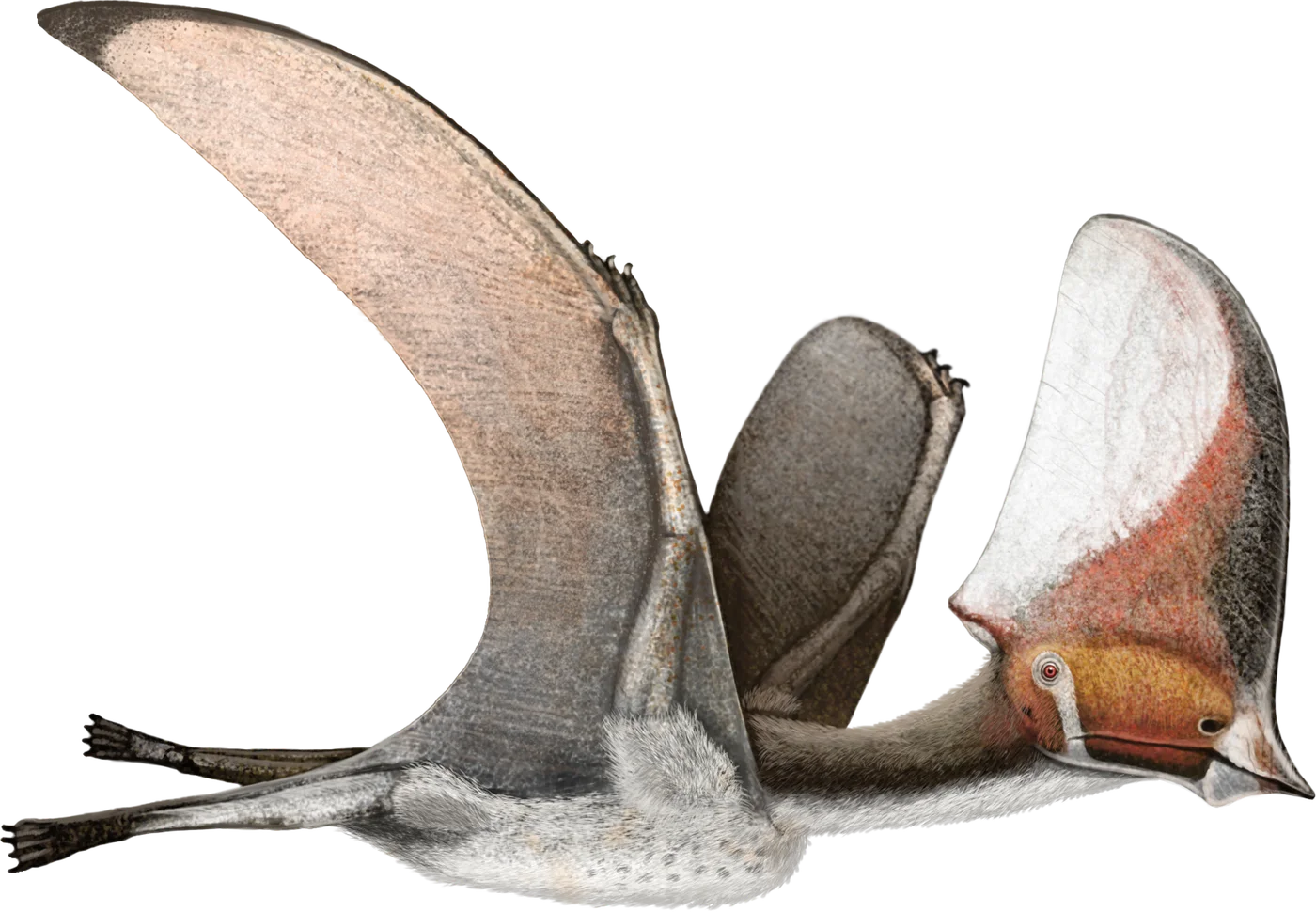
Caiuajara
Art: Andrey Atuchin
All illustrations are copyright their respective artists. Use of any image requires a paid licence — contact us for licensing enquiries.
Caiuajara
/ky-wa-ZHA-ra/The last of the tapejarids and also one of the best preserved. Caiuajara was discovered in a huge flock, bang in the middle of an ancient Brazilian desert. Its fossils help us to understand these creatures a bit more, including how they grew up and what their family life was like.
Pterosaur data
Mesozoic era · 252–66 Ma
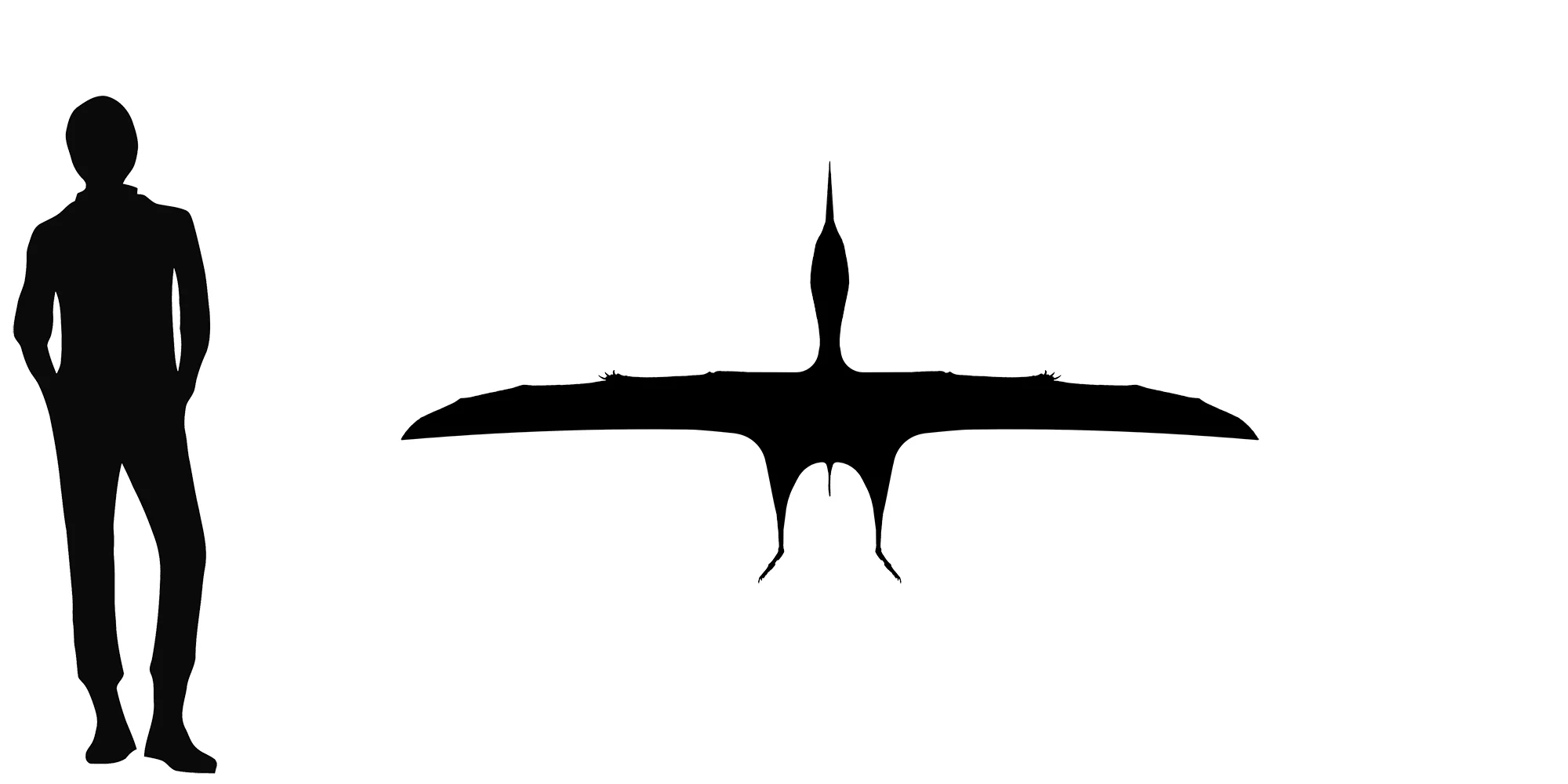
Wingspan
About this pterosaur
Brazilian tapejarid Caiuajara is one of the most exciting pterosaur discoveries of the last few years.
A massive bonebed of these animals was discovered by Alexandre Dobruski and his son in 1971 in the state of Parana, Brazil but the find was not reported until 2011.
The animals themselves were not described until three years later by a team including Alexander Kellner and Cristina Vega. The name, Caiuajara dobruskii honors the original discoverer and the Caiua Group in which the animals, forty-seven in all, were found.
The age of the pterosaur is very roughly placed at 85 million years ago, during the Santonian Stage of the Late Cretaceous, although this is somewhat uncertain.
All that is known, however, is that the animals had died, and possibly lived, in a desert environment. A close contemporary would have been the primitive iguana Gueragama, described in 2015. Tapejarids are thought to be either herbivorous or omnivorous pterosaurs, but with few plant remains, we have no idea what exactly they were feeding on.
We do know however that the bones have been preserved in three dimensions and that enough skulls are known to paint a proper portrait of the animal with relative confidence. We know that there are juvenile bones alongside those of the adults.
A complete ontogeny is preserved here, with the younger individuals having smaller skulls with smaller crests, while the bony crests of the adults have a shark fin profile.
The young must have been precocious, leaving the nest as soon as they hatched, thus limiting parental care. However, unlike most other pterosaurs, there does not seem to be any marked sexual dimorphism in the skeletons.
Usually, pterosaurs show strongly dimorphic features. The large and well-known genus Pteranodon and its relatives like Geosternbergia and Dawndraco show us that these particular creatures lived as part of a patriarchy, with a harem-based breeding system.
Males had been massive, with 7-meter wingspans and huge crests while the females were less than half their size.
The small non-pterodactyloid Darwinopterus shows us that males had prominent soft tissue crests on their heads while females did not.
Another recent pterosaur mass grave is that of the Early Cretaceous genus Hamipterus. The males are still much bigger than the females.
However, Caiuajara shows us that dimorphism was certainly far from the norm in pterosaurs. Neither is it that big, with a wingspan of 2.5 meters (8 feet), but geologically speaking it is still one of the youngest ever tapejarids.
Across the network
Credits