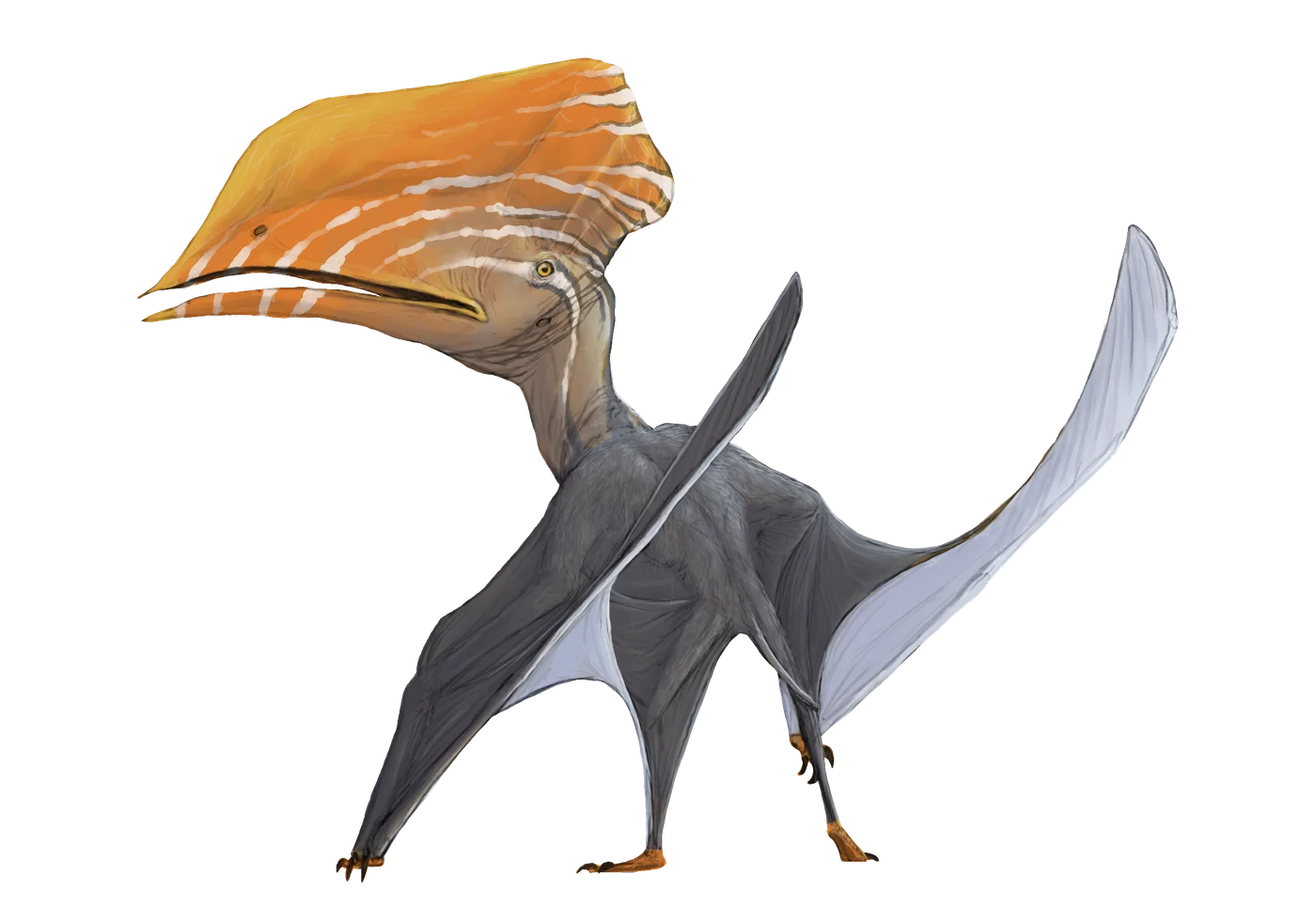
Caupedactylus
Art: Fabrizio De Rossi
All illustrations are copyright their respective artists. Use of any image requires a paid licence — contact us for licensing enquiries.
License this image
Available on Paleostock for commercial use
Caupedactylus
/kaw-pe-DAK-til-us/
This crested Brazilian pterosaur is named for the Tupi goddess of the sky.
Pterosaur data
Mesozoic era · 252–66 Ma
Wingspan

About this pterosaur
Caupedactylus ybaka is known from a single specimen discovered in 115-million-year-old limestone from the Romualdo Member of the Santana Formation exposed in northeastern Brazil's Araripe Basin. Initially described in 2013 by Alexander Kellner, the name is derived from the Tupi goddess of the sky, “Caupe,” and the Ancient Greek word “dactylus,” meaning finger, a common suffix among pterosaurs. The specific name, “ybaka,” is also derived from the Tupi language and means sky.
The skull of Caupedactylus is highly distinctive and well preserved. It measures 46 cm (18 inches) in length and is elongate with jaws that are toothless, tapered, and slightly down-turned at the tips. A large narrow crest grew from the top of the snout. Starting just behind the tips of the jaw, it rises sharply and at least doubles the height of the skull. The middle portion of the skull is damaged, so the crest's exact height is unknown, but is likely to have been highest over the middle of the snout or eyes. The lower jaw also bore a low crest on the chin. In profile, the skull looks remarkably similar to modern hornbills.
Only a few bones are known from the rest of the skeleton including a partial sternum, a partial left shoulder, a well preserved right shoulder and humerus, a single partial phalanx from the wing finger, and some rib fragments. Although the skeleton is incomplete, comparisons to other pterosaurs show that its wingspan would be just over 3 meters (10 feet).
Caupedactylus was initially determined to be a member of the Tapejaridae, an especially speciose radiation of pterosaurs found in Lower Cretaceous rocks from around the world, but especially common in this part of Brazil. Tapejarids are characterized by their toothless jaws with down-turned tips and large crests on their snouts and chins. Within the broader pterosaur family tree, Tapejarids are most closely related to other toothless crested families like thalassodromids, chaoyangopterids, and azhdarchids, with the whole group being known as azhdarchoids.
Caupedactylus was found in limestone that formed under the waves of the incipient Atlantic Ocean, but lived close enough to the shore that it was probably not fully marine in its habits. Tapejarids are thought to have been omnivorous, eating fish, invertebrates, and small terrestrial vertebrates, as well as fruit, seeds, and other plant material. It's likely that Caupedactylus was similar in its habits, and would have had a wide variety of food at its disposal.
Across the network
Credits