Jeholopterus
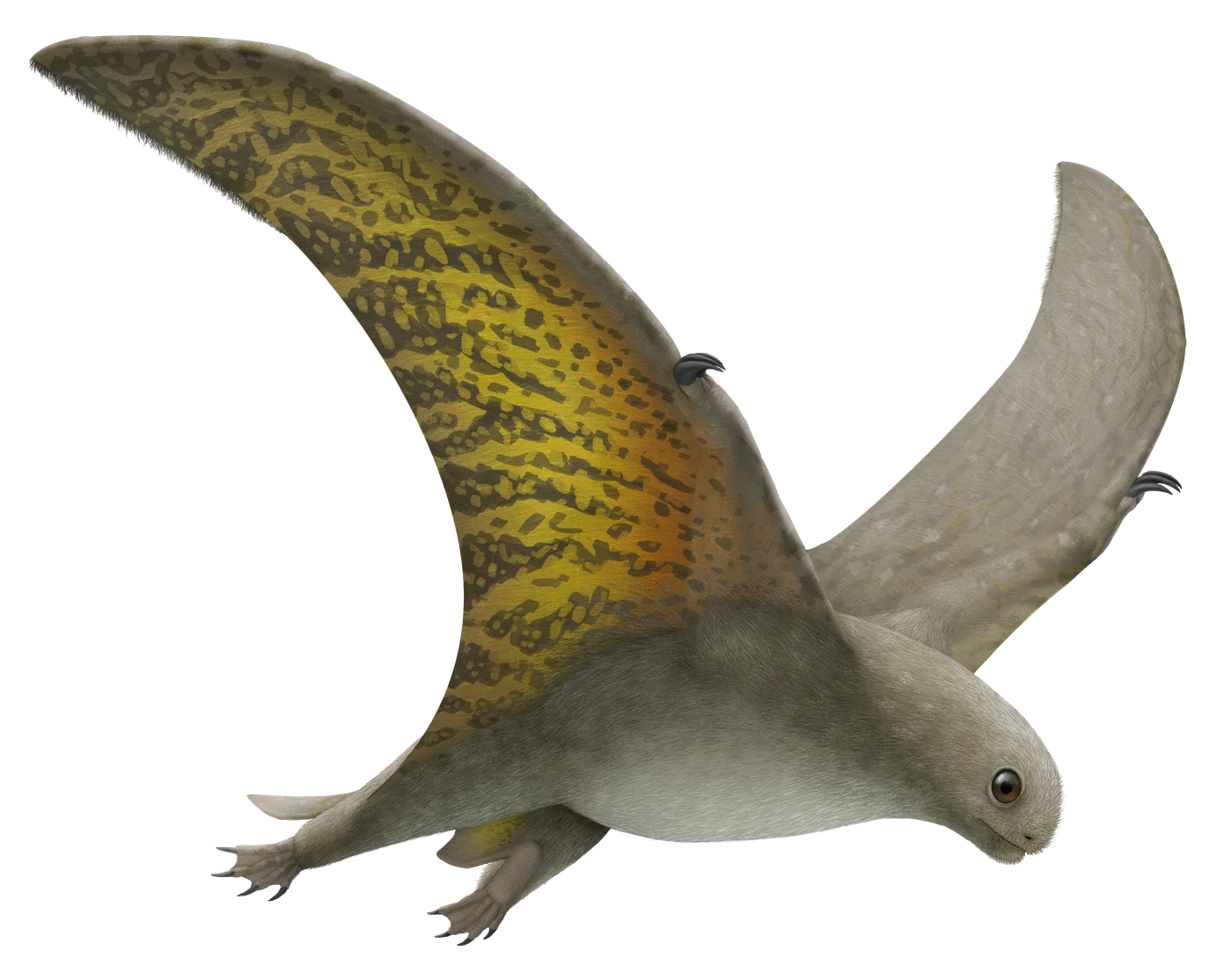
Art: Vitor Silva
All illustrations are copyright their respective artists. Use of any image requires a paid licence — contact us for licensing enquiries.
Jeholopterus
/jeh-hol-OP-ter-us/
This Chinese insect-hunting pterosaur is known from an incredible specimen including wing membranes and shaggy hair covering its body.
Pterosaur data
Mesozoic era · 252–66 Ma
About this pterosaur
Jeholopterus was named in 2002 by paleontologists Wang Xiaoling and colleagues based on a well preserved specimen with soft tissues discovered in the Daohugou Bed in Inner Mongolia Province, China. The Daohugou Bed was originally considered to be from the lower portion of the Lower Cretaceous Yixian Formation, but recent dating shows that it was actually laid down in the Middle Jurassic, 164 million years ago and part of the Tiaojishan Formation.
The skeleton was preserved in articulation on a slab of limestone formed in the bottom of a lake. The animal was fossilized lying on its belly, with its wings on its side. The wingspan was about 90 cm (35 inches), about the same size as a goose. The skull is incompletely preserved, but shows that it had a very short, rounded snout lined with numerous short, sharp teeth. The eyes were large, and in life the face would have looked something like a Muppet. The neck was unusually short compared to other pterosaurs, being only about the length of the skull. The wings are robust and the three free fingers bear unusually large claws. The legs are incompletely preserved, and the tail was not found.
The wings preserve not only the bones, but traces of the wing membranes as well. These traces, among the best preserved on any pterosaur, show that the wing membrane stretched from the tip of the wing finger to the ankle, and were strengthened by parallel internal fibers. Like other pterosaurs, the body was covered in short hair-like fibers, and would have looked quite fluffy in life.
When initially described in 2002, Jeholopterus was considered to be an anurognathid, a family of small short-snouted and short-tailed pterosaurs known from Middle and Upper Jurassic rocks around the world. Anurognathid fossils are only known from lagerstätten, fossil localities with exceptionally well-preserved fossils, often including soft tissues, such as skin, hair and feathers. This is likely due to the delicate nature of most anurognathids, as all other species are smaller than Jeholopterus.
Subsequent research has affirmed that Jeholopterus is an anurognathid, and that it's part of an Asian lineage known as batrachognathines. In addition to Jeholopterus, batrachognathines include Dendrorhynchoides, also from the Tiaojishan Formation, and Batrachognathus from the Upper Jurassic of Kazakhstan. Based on the short sharp teeth, and wing shape, anurognathids are thought to have been acrobatic aerial insect hunters, similar to living bats, and swifts, swallows, and nightjars among birds.
Across the network
Credits