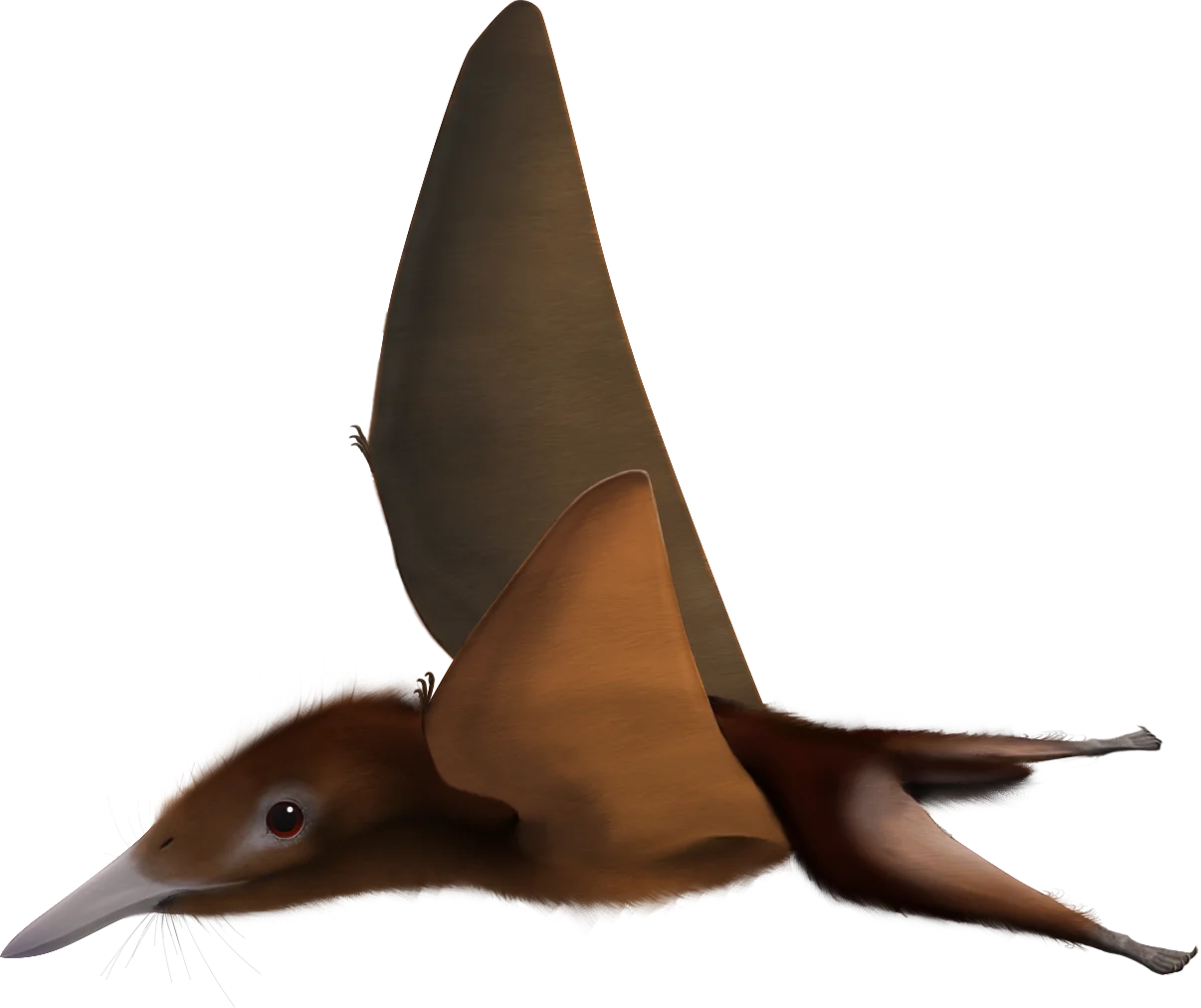
Nemicolopterus
Art: Chris Masnaghetti
All illustrations are copyright their respective artists. Use of any image requires a paid licence — contact us for licensing enquiries.
License this image
Available on Paleostock for commercial use
Nemicolopterus
/nem-ik-oh-LOP-ter-us/Whether it is a baby of another pterosaur or an individual in its own right, Nemicolopterus is the smallest pterosaur yet found. It soared through the Chinese forests on narrow, long wings, powering its stout body like a fluffy little bullet.
Pterosaur data
Mesozoic era · 252–66 Ma
Wingspan

About this pterosaur
This tiny pterosaur’s actual identity has been disputed in paleontological circles. What is certain though, is that this animal is known from a rather diminutive holotype specimen, the smallest non-hatchling pterosaur ever known.
But it is still not fully grown, thus being a subadult instead. It is still larger than the many hatchling pterosaurs – or flaplings as they are sometimes called – that have been found over the years. It hails from the Jiufotang Formation of around 120 million years ago, the Aptian Stage of the Early Cretaceous.
The type and only species of Nemicolopterus is N. crypticus. It was named in 2008 by Wang, Kellner, Campos, Zhou and colleagues on the basis of a single fossil. The whole name translates as “hidden forest-dwelling wing”, an apt description for the genus.
The whole animal is a little over 5 centimeters long, with a 25-centimeter wingspan. It has a large head and a pointed beak, but it still has some roundedness to its body.
It might have been either omnivorous or a pure insectivore and given that the only specimen was a subadult, either situation might have been likely.
Pterosaurs went through a number of stages throughout their ontogeny, and the young were not cared for as much as one might expect. In fact, it is now thought that pterosaurs laid their eggs and left them behind.
The flaplings came out fully developed, able to find their own food.
Having precocious offspring means that the young were often very different from their parents.
They could easily coexist with the adults by means of niche partitioning. There is a suggestion that Nemicolopterus is the offspring of the contemporary Sinopterus, as argued by Darren Naish. Sinopterus was a tapejarid, one of the pterosaurs with short faces and strange bony crests.
These were azhdarchoids – as is N. crypticus – but instead of hunting, might have eaten fruit or instead they may have been generalists, taking both plants and small animals.
This little azhdarchoid’s contemporaries include the arboreal predator Microraptor, now known from its feather coloration, diverse avian theropods and larger non-avian dinosaurs like the ankylosaur Chuanqilong and the tyrannosauroid Sinotyrannus.
Other pterosaurs from the Jiufotang include the large Liaoningopterus and Moganopterus, and much smaller ones like Eopteranodon.
All these pterosaurs coexisted due to adult partitioning in the environment as well as differences among hatchlings and juveniles.
Across the network
Credits