Draigwenia
All illustrations are copyright their respective artists. Use of any image requires a paid licence — contact us for licensing enquiries.
Draigwenia
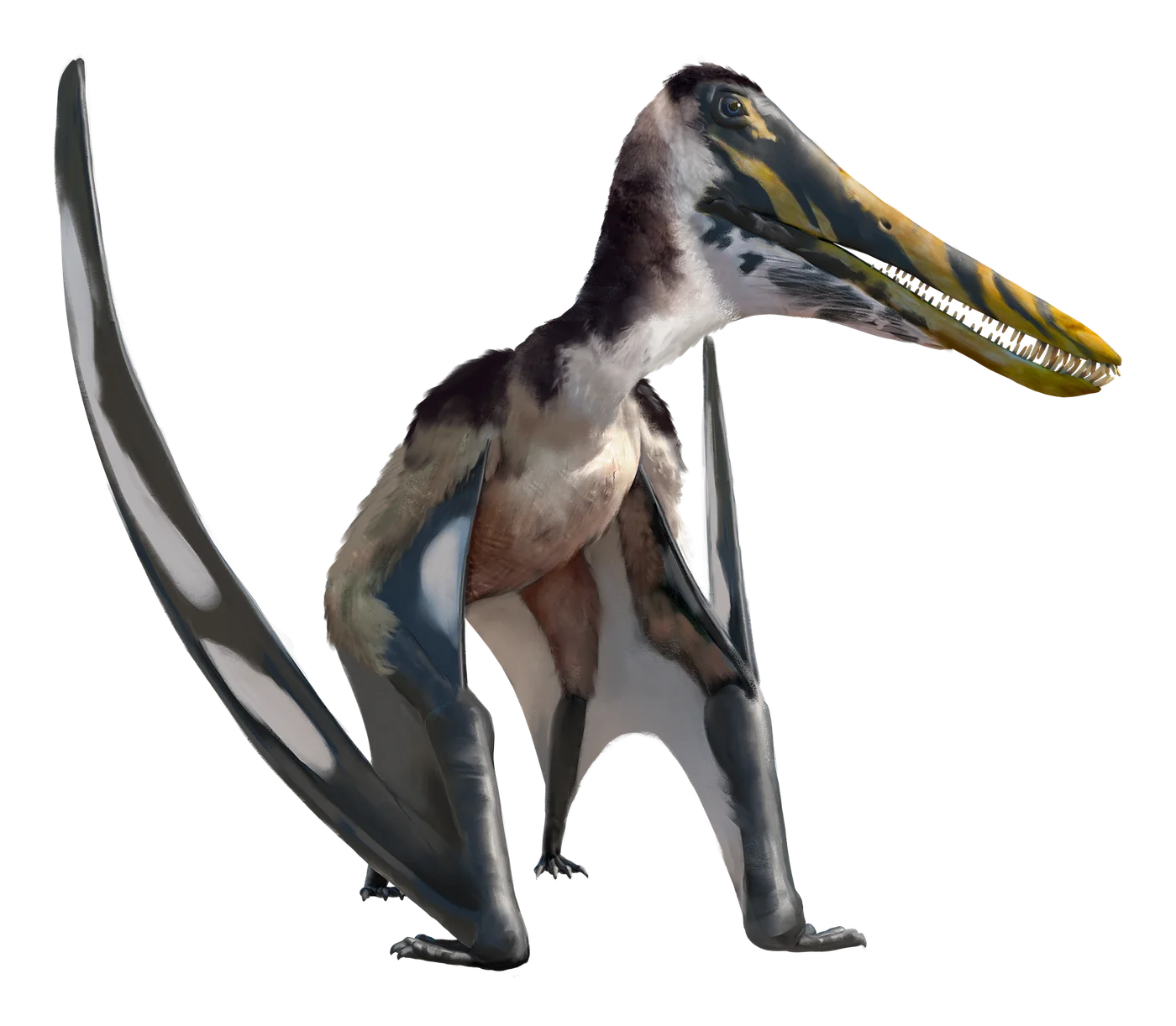
Draigwenia was a marine fisher known only from the tips of its upper jaws.
Pterosaur data
Mesozoic era · 252–66 Ma
About this pterosaur
In 1870, Harry Govier Seeley named a new species of pterosaur, Ornithocheirus platystomus, from the Lower Cretaceous Cambridge Greensand near Cambridge, England. In 1914, Reginald Hooley created the genus Amblydectes for Ornithocheirus crassidens, and assigned O. platystomus and O. eurygnathus to the new genus. In a 2021 review of Amblydectes, paleontologist Borja Holgado found that A. crassidens is a valid species, and that the specimens of A. eurygnathus belonged to that species. He also found that the species A. platystomus is valid, but didn’t belong to the genus Amblydectes. He named a new genus for this species, Draigwenia. The genus name is derived from the Welsh “Y Ddraig Wen,” meaning “the white dragon.” The species name is Greek for “wide mouth.”
The only known specimen is a fragment just under 3 cm long (just over 1 inch), and from the distal end of the rostrum. When seen from the side, the upper surface of the rostrum rises gently and is at a 27° angle compared to the tooth row. The fragment is about twice as tall as it is wide, with its upper surface forming a rounded ridge.
The fragment preserves 3 pairs of alveoli and is missing its tip, and presumably the first pair of teeth. The alveoli are very small and widely spaced, but no teeth were found with the fragment. The small, widely spaced teeth and the upper rostrum at a 27° angle are unique features that set Draigwenia platystomus apart from other pterosaurs.
Holgado considered Drawigwenia to be some kind of lanceodontian, a member of a large lineage of tooth-bearing aerial fishers. Unfortunately, the fragmentary nature of the specimen precluded a more concrete placement. In a separate 2021 study, Brian Andres found that Draigwenia platystomus was most closely related to Ornithocheirus simus, the only certain member of the genus Ornithocheirus. Both Ornithocheirus and Draigwenia share small, widely spaced teeth, but Ornithocheirus is substantially larger, and bore a large distal crest with a nearly vertical front edge. At Pteros, we’ve reconstructed Draigwenia as a lanceodontian of uncertain affinities, following the interpretation of Holgado. As reconstructed, it would have a wingspan of about 1.6 m (5 feet).
Draigwenia’s remains are found in rocks that formed under a warm to temperate shallow sea about 110 million years ago. Although fragmentary, it’s likely that Draigwenia ate fish, and hunted by grabbing them from near the surface.
Across the network
Credits